
Shopping for a grinder used to be fairly simple. Pick a size, choose a color, check the price, and move on.
That has changed.
In 2026, grinder design has become much more varied. There are traditional metal grinders, stainless steel models, electric grinders, toothless mills, compact travel grinders, multi-chamber designs and natural wooden options. Current grinder roundups are increasingly separating products by material, grind consistency, portability and intended experience rather than simply calling one model the winner.
That is useful because the best grinders for weed are not necessarily the ones with the largest number of chambers or the most complicated construction. A good grinder starts with a simpler question: does it feel good to use and produce a consistent result without unnecessary frustration?
Here is what deserves attention.
Grind consistency matters more than extra features
A grinder has one main job.
It should break flower into reasonably uniform pieces without turning the process into work.
An inconsistent grinder may leave some pieces large while other material becomes much finer. That is why consistency has become such a visible category in current 2026 grinder comparisons. Some manufacturers now even offer interchangeable plates or different grinding systems specifically to alter texture.
More features are not automatically better.
Four-piece and five-piece grinders have their place, but someone who values simplicity may be perfectly happy with a well-made two-piece design. Fewer components also mean fewer threads, screens and small areas to maintain.
The quality of the basic mechanism matters more than counting chambers.
Material changes the entire character of a grinder
Metal still dominates the grinder market, particularly aluminum and stainless steel. Plastic remains common at lower price points. Wood occupies a much smaller but increasingly interesting position.
Each feels different.
Metal tends to feel cool, industrial and precise. Plastic is light. Natural wood is warmer in the hand and every piece carries visible grain and color variations.
That difference is no longer purely cosmetic. Modern cannabis-accessory design is increasingly moving toward products that can blend into a thoughtfully designed home instead of looking like something that immediately needs to be hidden in a drawer.
This is where handcrafted and natural-material grinders have started to stand apart.
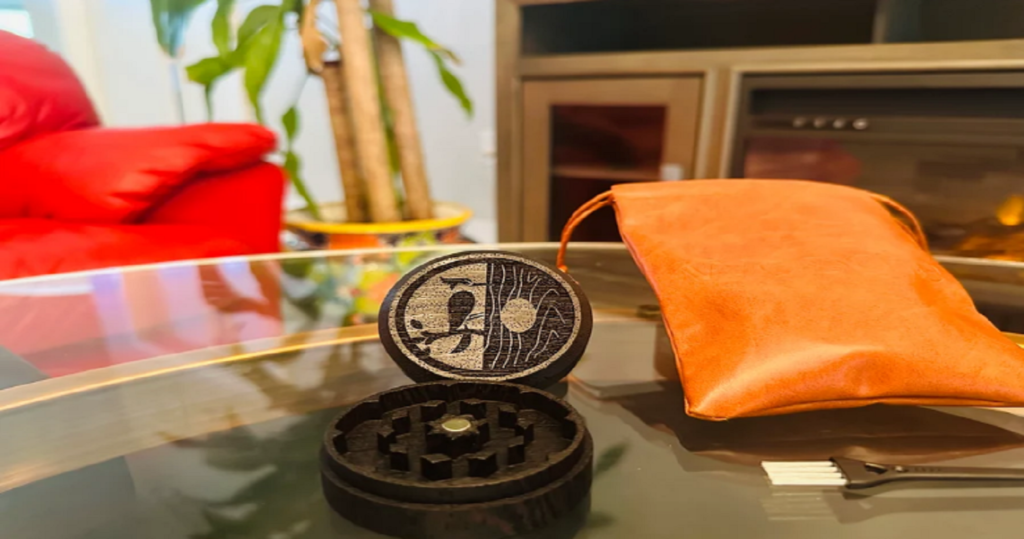
Woodie, for example, makes its grinders from solid exotic hardwood rather than covering another material with a decorative wooden shell. Its design uses a simple two-piece format with solid-wood diamond-shaped grinding teeth. The pieces are CNC machined and then finished by hand.
That produces a very different object from the typical anodized metal grinder.
Two-piece or four-piece?
This choice is mostly about priorities.
A four-piece grinder normally provides separate grinding and collection areas, often with an additional fine-material screen. It gives the user more separation but also creates additional components to clean.
Two-piece grinders take the opposite approach.
Open it, grind, access the material.
There is something appealing about that simplicity, particularly for people who have accumulated complicated accessories over the years and now want fewer things to deal with.
Neither approach is universally superior.
The better question is which design matches the way you actually use and maintain your accessories.
Pay attention to the teeth
People spend a lot of time comparing grinder bodies and surprisingly little time looking at the grinding surface.
That is a mistake.
Tooth placement, shape and spacing influence how smoothly the grinder turns and how material moves through it.
Woodie takes an unusual approach here. Its diamond-shaped teeth are machined directly from the solid hardwood rather than adding conventional metal grinding surfaces.
It gives the grinder a consistent material story rather than making the wooden exterior purely decorative.
For buyers specifically looking for a natural alternative, that detail matters.
A grinder should feel right in your hand
This is difficult to communicate with specifications.
Some grinders technically work well but feel awkward. Others are too narrow, overly heavy or uncomfortable to twist.
The physical feel becomes especially important with an accessory that is handled constantly.
Natural hardwood has an obvious tactile advantage for people who prefer warmer materials. Grain, texture and subtle variations also mean two wooden grinders will never look completely identical.
That individuality is almost impossible to reproduce with mass-produced plastic or metal finishes.
Think about how the grinder will age
A grinder is not something most people want to replace every few months.
Look at construction before novelty.
Are the components unnecessarily complicated? Are there tiny threaded sections that will collect debris? Can the grinder be maintained easily? Does the material improve visually with normal care or simply show wear?
Wood requires slightly different care from metal. It should not be soaked or exposed to excessive heat or water. Woodie recommends occasional exterior conditioning with a small amount of beeswax or hemp oil when required.
For someone who enjoys natural materials, that maintenance can feel closer to caring for a wooden kitchen tool than cleaning another piece of hardware.
The best grinder may also be the simplest one
Electric grinders and modular systems are gaining attention in 2026, and they make sense for certain buyers.
But innovation does not always mean adding technology.
There is another direction happening at the same time: fewer components, better materials, intentional construction and products that are pleasant enough to keep for years.
That is why natural grinders deserve a place in the conversation about the best grinders for weed.
A solid exotic hardwood grinder is not trying to imitate an electric device or compete with a five-chamber metal system feature for feature. It offers something different: simplicity.
No flashy mechanism. No unnecessary layers.
Just material, craftsmanship and the daily act of using something that feels considered.
In a category full of products trying to add one more feature, choosing something deliberately simple can feel surprisingly modern.