
Two cannabis plants can look almost identical for weeks. Both may carry deeply serrated fan leaves, sturdy stems and healthy new growth, yet one may eventually produce pollen while the other develops flowers with delicate, hair-like stigmas. That is why identifying a male versus a female cannabis plant is less about judging its overall silhouette and more about recognizing its reproductive structures.
The distinction matters in cannabis botany and seed breeding, but the internet is full of shortcuts that do not hold up: counting leaf fingers, checking whether a plant looks bushy, or assuming its indica or sativa label reveals its sex. This guide separates reliable floral signs from those common myths, including what can—and cannot—be learned before flowers are visible.
Quick answer: Male cannabis plants typically develop rounded, pollen-producing flower structures. Female plants develop small flowers with protruding stigmas, commonly seen as two fine hairs. Before those structures appear, ordinary leaf shape and stem height are not dependable ways to tell the sexes apart. Some cannabis plants can also express both male and female flowers.
Male vs Female Cannabis Plants: The Key Differences
Cannabis is predominantly dioecious, a botanical term for species in which male and female flowers are usually carried on separate plants. A male plant produces pollen-bearing, or staminate, flowers. A female produces pollen-receiving, or pistillate, flowers and can form seeds after pollination. These functions are far more meaningful for identification than a general impression of plant size.
| Feature | Typical male plant | Typical female plant |
|---|---|---|
| Early reproductive sign | Small rounded structures, sometimes on short stalks | Tear-shaped flower structure, often with two visible stigmas |
| Developed flowers | Clusters of pollen-bearing flowers | Clusters of flowers bearing stigmas and protective bracts |
| Biological role | Supplies pollen | Receives pollen and can form seeds |
| Fan-leaf shape | Not a dependable sex marker | Not a dependable sex marker |
| When identification becomes reliable | After recognizable reproductive structures develop | After recognizable reproductive structures develop |
University extension resources consistently emphasize reproductive structures. A plant's exact appearance and developmental timing may vary by genetics and environment, so treat any single rule about plant height or calendar age with caution.
What Do Early Male Cannabis Flowers Look Like?
At first, an emerging male flower can be no bigger than a tiny rounded bud where a side branch joins the main stem. As it develops, the structure becomes more recognizable: a compact rounded form that may sit on a short stalk. Mature male flowers open to expose the stamens, which release pollen. Several flowers can occur together in branching clusters.
It is easy to mistake a very immature reproductive structure for a harmless piece of new growth. A rounded shape alone, especially in a blurry photograph, is not enough to establish sex. The presence of clearly developing male flower structures is the meaningful clue—not a slightly taller plant or a less leafy top.
What Do Early Female Cannabis Flowers Look Like?
Female pre-flowers are typically described as small, tear-shaped structures at a node, often with two pale, thread-like stigmas extending from them. The stigmas are receptive surfaces for pollen; they are not ordinary leaf hairs. As flowering progresses, additional flowers form compact clusters with more visible stigmas. Their color can change as the flowers mature, so white hairs are useful for early recognition but are not a permanent feature of every flower.
One confusing detail is the presence of stipules—small pointed green appendages near the base of a leaf stalk. Stipules appear on cannabis plants regardless of sex. They may sit close to the emerging flowers, but they are not female stigmas. If the structure you are studying is simply a green, spear-shaped stipule, it does not prove anything about the plant's sex.
Where Do Pre-Flowers Appear on a Cannabis Plant?
One of the most useful botanical terms here is node: the point on a stem where a leaf or branch attaches. Early reproductive structures commonly develop around these junctions. Leaves, stipules, side shoots and tiny flowers can sit close together, making casual photos hard to interpret.
To understand an identification image, look for a close-up that distinguishes the main stem, leaf stalk, stipule and actual flower. A photograph that shows only fan leaves, without the node or any reproductive detail, does not supply the evidence needed for a confident male/female conclusion.
Can You Tell Whether a Cannabis Plant Is Male or Female Before Flowering?
Before recognizable flowers or pre-flowers develop, not reliably by sight. Oregon State University Extension describes vegetative male and female hemp plants as visually indistinguishable. Some plants display pre-flowers while they are still in a largely vegetative growth stage, which explains why people sometimes describe sex identification as possible “before flowering.” What they usually mean is before conspicuous flower clusters, not before any floral tissue has formed.
Timing varies. A plant may show early signs within several weeks of growth, but a precise date is not universal. Developmental stage, genetics and growing conditions all affect how quickly the structures become visible. For situations where very early certainty is necessary, specialist laboratories can use molecular tests on plant tissue, although such testing is not the same thing as guessing from a leaf photograph.
Do Male and Female Cannabis Plants Have Different Leaves?
This is one of the most persistent identification myths. Both sexes can produce the familiar palmately compound cannabis leaves with toothed margins and multiple leaflets. Leaflet width, the number of “fingers,” overall leaf size and color are variable characteristics—not reliable markers of sex.
Some traditional comparisons describe male plants as taller and more loosely branched, and female plants as bushier. Those tendencies can overlap substantially. Plant structure responds to genetics, age, light, available space and other environmental conditions, so appearance does not function as a male/female test.
Indica and sativa labels describe something different
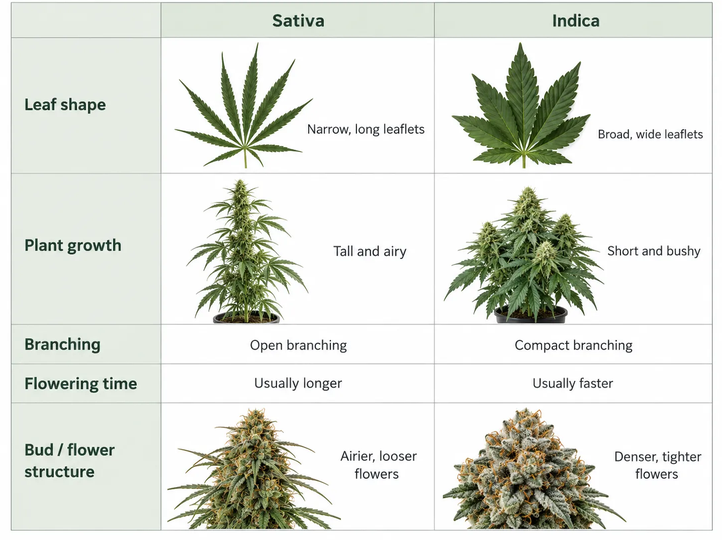
It also helps to distinguish sex from the familiar indica/sativa vocabulary. When comparing a sativa plant vs indica plant, people commonly discuss broader or narrower leaflets, branching patterns and plant stature. These descriptions are not a shortcut for identifying male or female flowers. A plant's sex and its marketed indica/sativa classification are separate questions, and modern hybrids can combine contrasting physical traits.
That distinction prevents two common mistakes at once: calling a broad-leaf plant female, or assuming a narrow-leaf plant must be male. Neither claim is supported by the visual evidence.
What About Plants With Both Male and Female Flowers?
Not every cannabis plant fits a simple two-column picture. Cannabis can show monoecious expression, with male and female flowers on the same individual, and some plants exhibit hermaphroditic or mixed-sex expression. These terms describe related but not identical floral arrangements, and they are not automatically interchangeable.
Recent research reviews cannabis sex expression as a combination of underlying genetics and developmental, hormonal and environmental influences. In other words, XX/XY sex chromosomes are important, but the flowers a particular plant expresses can be more complicated than its chromosomal starting point. If a plant bears recognizable pollen-producing structures and female flowers, the observed flower types matter more than any presumed sex based on leaf shape.
Regular vs Feminised Cannabis Seeds: What Is the Difference?
The language used to describe cannabis seeds is another source of confusion. A regular seed line may produce male or female plants, while feminised seeds are produced with the intention of yielding predominantly female plants. Feminised does not describe a unique leaf shape, and it does not mean that sex expression is immune to all biological variation.
It is also worth separating these seed labels from the words photoperiod and autoflowering. The former concern the plant's flowering response, while regular and feminised describe the expected sex distribution. Neither designation tells you whether an emerging structure at a node is a pollen-bearing flower or a female flower; that still requires the appropriate evidence.
For someone reading a seed catalogue, the most useful questions are straightforward: Which breeder produced the line? What seed format is stated? Are the breeder's cultivar details clear? A product label is valuable background information, but an individual plant's visible reproductive structures remain the basis for visual identification.
Five Common Male vs Female Identification Mistakes
- Counting leaf fingers. Three, five, seven or more leaflets do not establish plant sex. Cannabis leaves can vary with development and genetics.
- Using height as proof. Males may sometimes appear taller or mature earlier, but an individual plant can easily break that pattern.
- Calling stipules female hairs. A pointed green stipule is not a stigma; the two structures play different roles.
- Deciding from a seed's appearance. Seed markings, shape and color cannot reliably reveal whether the plant will express male or female flowers.
- Assuming one sex must always remain visually exclusive. Mixed-sex flower expression exists, so a careful description should record what reproductive structures are actually present.
A More Reliable Way to Interpret Cannabis Plant Photos
For educational comparisons, the best images do not simply place two full plants side by side and label one “male” and the other “female.” Instead, they show the part of the plant that supports the label. A useful male example clearly identifies an unopened pollen-bearing flower or an open flower with visible stamens. A useful female example highlights the flower structure and its stigmas. Captions should say whether the photograph shows an early pre-flower or a more mature cluster.
When an image is too young, obscured or distant to show those details, the accurate answer is that the plant's sex cannot be confirmed from that picture. That uncertainty is better botanical information than an attractive but misleading visual chart.
Frequently Asked Questions
Can you tell male and female cannabis plants apart by their fan leaves?
No. Both can have broad, narrow, large or small fan leaves. Look for distinguishable reproductive structures rather than relying on leaflets or overall leaf shape.
What is the earliest visible difference between male and female cannabis plants?
Recognizable pre-flowers provide the earliest dependable visual difference: rounded male flower structures versus female flower structures often showing fine stigmas. Timing varies between plants.
Are two white hairs always a sign of a female plant?
Two thread-like stigmas emerging from a female pre-flower are a strong identification clue. The surrounding structure matters; unrelated fibers, leaf hairs or photographic artifacts should not be mistaken for stigmas.
Do male cannabis plants produce flowers?
Yes. Male cannabis plants produce flowers with stamens that release pollen. They do not develop the same compact, stigma-bearing flower clusters typical of female plants.
Can a cannabis plant develop both male and female flowers?
Yes. Monoecious and mixed-sex floral expression occur in cannabis. The terms describe different reproductive arrangements, and genetics and environmental factors can influence how sex is expressed.
Are feminised seeds guaranteed to produce female plants?
Feminised seeds are intended to yield overwhelmingly female plants, but absolute guarantees about the final flowers on every individual plant overlook biological variation and possible mixed-sex expression.
Does indica or sativa tell you whether a plant is male or female?
No. Indica/sativa terms traditionally describe broad patterns of plant appearance or breeder classification, not the plant's reproductive sex.
Final Takeaway
The easiest way to remember the distinction is simple: leaves describe a plant's appearance; flowers reveal its reproductive structures. Height, leaf width and leaflet count may be interesting botanical observations, but they do not substitute for the pollen-bearing flowers of males or the stigma-bearing flowers of females. Understanding that difference makes cannabis identification more accurate—and helps readers interpret seed terminology without confusing genetics, growth habit and sex.
Sources and Further Reading
- University of Saskatchewan: Female vs. Male Cannabis — botanical photographs and pre-flower characteristics.
- Oregon State University Extension: Hemp Sex-Ed — sex identification and limits of visual inspection.
- Utah State University Extension: Frequently Asked Questions About Cannabis — reproductive structures and timing.
- Journal of Experimental Botany: Genes Associated with Sex Expression — genetics and flower development.
- 2026 review: Hermaphroditism in Cannabis sativa — mixed-sex expression and biological complexity.
Editorial note: This article is general botanical education. Laws concerning cannabis seeds, cultivation and possession differ by location. Follow applicable regulations.